Are you a student at FAST NUCES? Or are you planning to apply soon? Keeping track of your college grades is super important. Your Semester GPA (Grade Point Average) and Cumulative CGPA (Cumulative Grade Point Average) show how well you are doing in your classes.
Whether you want to stay in good academic standing, qualify for the Dean's List, or secure a great job after graduation, you need to monitor these scores. This guide will help you understand the FAST NUCES grade calculation process. We make it simple and clear so you can focus on studying instead of worrying about the math. You can use our free calculator at the top of the page to find your scores instantly!
The National University of Computer and Emerging Sciences, widely known as FAST NUCES, is one of Pakistan's top higher education institutions. Established in 2000, it grew out of the famous FAST IT institutes founded in 1984. The university is highly respected for producing excellent graduates in computer science, software engineering, and business.
FAST NUCES has a strong reputation for academic rigor. It is recognized by the Higher Education Commission (HEC) of Pakistan and accredited by the Pakistan Engineering Council (PEC). It consistently ranks among the very best universities for computer science and engineering in the country.
The university operates multiple modern campuses across Pakistan. Its graduates are highly sought after by top local and international technology firms. Students enjoy a busy campus life filled with technical competitions, sports, and societies that prepare them for successful careers.
FAST NUCES offers a wide range of academic programs at both undergraduate and graduate levels. Here is a list of the popular degrees you can pursue at FAST University:
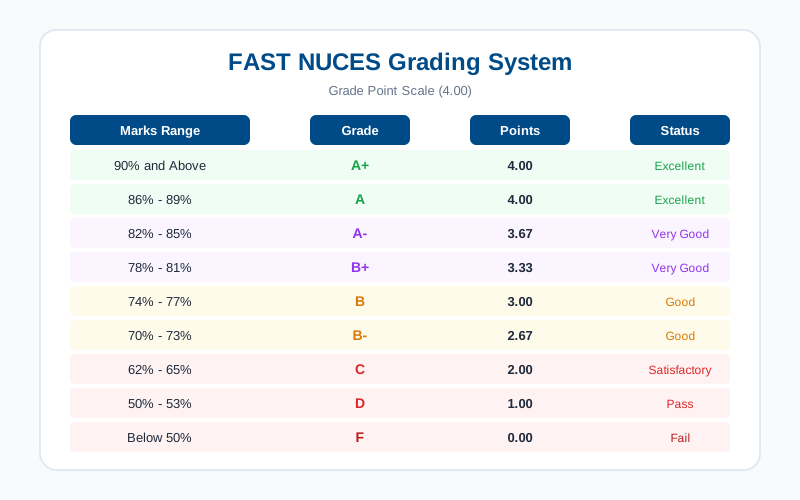
Before you start your calculations, it is helpful to know how FAST NUCES grades work. The university uses a 4.0 scale to measure student performance. Your final letter grade is decided by either absolute grading (fixed marks ranges) or relative grading (curving based on the class average).
| Marks Range (Absolute) | Letter Grade | Grade Points |
|---|---|---|
| 90% and Above | A+ | 4.00 |
| 86% - 89% | A | 4.00 |
| 82% - 85% | A- | 3.67 |
| 78% - 81% | B+ | 3.33 |
| 74% - 77% | B | 3.00 |
| 70% - 73% | B- | 2.67 |
| 66% - 69% | C+ | 2.33 |
| 62% - 65% | C | 2.00 |
| 58% - 61% | C- | 1.67 |
| 54% - 57% | D+ | 1.33 |
| 50% - 53% | D | 1.00 |
| Below 50% | F | 0.00 |
Note: To get your degree at FAST NUCES, your final Cumulative GPA must be at least 2.00. Scoring an F means failing, and you must repeat the subject to pass.
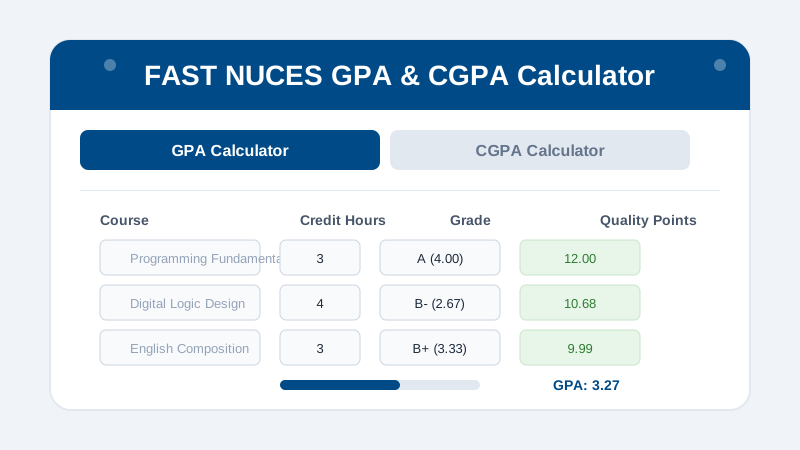
Finding your semester Grade Point Average (GPA) is very easy. Follow these simple, numbered steps:
Suppose a student took 3 courses this semester:
Total Quality Points = 12.00 + 10.68 + 9.99 = 32.67
Total Credit Hours = 3 + 4 + 3 = 10
Semester GPA = 32.67 / 10 = 3.27
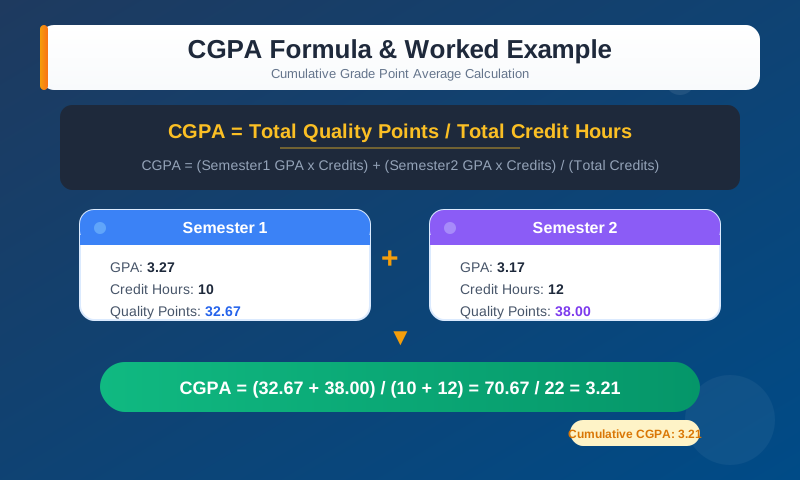
Your Cumulative Grade Point Average (CGPA) shows your overall performance across all the semesters you have completed. Here is how you can calculate your CGPA:
Suppose a student completed 2 semesters:
Grand Total Quality Points = 32.67 + 38.00 = 70.67
Grand Total Credit Hours = 10 + 12 = 22
Cumulative CGPA = 70.67 / 22 = 3.21
FAST NUCES operates five distinct campuses across Pakistan. Each campus offers modern facilities and the same high academic standards:
Universal Grading System:
Please keep in mind that GPA and CGPA calculation methods are completely identical across all FAST NUCES campuses. No matter which campus you study at, the grading scale and calculations remain exactly the same.
It is very simple! Visit cgpacalculator.pk, select your course grades and credit hours, and our smart tool will show you your highly accurate GPA instantly.
For undergraduate programs at FAST NUCES, a grade of D (1.00 grade point) is technically the minimum passing grade. However, some courses require a C (2.00 grade points) or higher to satisfy pre-requisite requirements.
GPA (Grade Point Average) measures your performance in a single semester. CGPA (Cumulative Grade Point Average) is the average of all your semesters combined.
If your CGPA falls below 2.00, you will be placed on academic probation. You must raise your CGPA in the next semester to remain in good standing and avoid academic warning or dismissal.
Yes! When you repeat a course with a low grade (such as C-, D+, D, or F), the new grade replaces the previous lower grade in your CGPA calculation, helping you improve your overall score.
Yes, the final grade points assigned to each letter grade (e.g., A- is 3.67, B+ is 3.33) are exactly the same. The only difference is how the letter grade is determined: relative grading uses a curve based on class average, while absolute grading uses fixed marks ranges.